Compiled by Chuck Olson


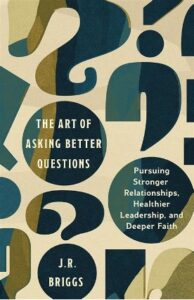
The Art of Asking Better Questions, written by leadership consultant J.R. Briggs, is packed full of insights as he makes a compelling case for the inestimable value of asking better questions. Here are three of them:
• The quality of your life is determined by the quality of the questions you ask God, yourself, and others.
• If you change your questions, you change your life—and the lives of those around you.
• What if the best leaders aren’t those who know the right answers but are instead those who ask the right questions?
Over the years, I have found that teeing up a clear, thought-provoking question often provides an invaluable onramp to out-of-the-box thinking and unanticipated outcomes. Check out these Book Notes to deepen your overall commitment and daily practice of leading by asking.

Chuck Olson
Founder | Executive Director
Lead With Your Life
Title: The Art of Asking Better Questions: Pursuing Stronger Relationships, Healthier Leadership, and Deeper Faith
Author: J.R. Briggs
Copyright: 2025
Book Description:
In The Art of Asking Better Questions, J.R. Briggs offers a thoughtful exploration of how intentional, well-crafted questions can transform relationships, leadership, and spiritual growth. Guided by the wisdom of Jesus as the ultimate question-asker, this book introduces four levels of questions designed to address different purposes and provide practical tools to improve your conversations.
If you want information, Google it. But if you want wisdom and connection, you need to become a person who asks better questions. Briggs argues that the quality of your life is determined by the quality of the questions you ask God, yourself, and others. There’s not a single area where improving the quality of your questions won’t improve your life and the lives of those around you.
Book Quotes:
The quality of your life is determined by the quality of the questions you ask God, yourself, and others. LOCATION: 10
Without a good question, a good answer has no place to go. LOCATION: 62
We live in a world that has conditioned us toward answers. We’ve been taught to give the right answers, yet little attention has been given to teaching us how to ask the right questions. We don’t have a shortage of information; we have a shortage of wisdom, curiosity, and wonder. Asking good questions is a lost art. LOCATION: 69
The questions we ask often reveal the values we hold. The questions we ask determine the life we live. Consider the most significant questions you’ve asked or been asked in your life. Who am I? What will I do with my life? What’s most important to me? What is true, good, and beautiful? Will you follow me? Will you accept the job? Will you trust me? Will you marry me? LOCATION: 87
Questions are so powerful researchers have described them as having the ability to hijack our brains…Which means that when you ask someone a question, you have hijacked their thoughts, even if for just a brief moment. A good question is an invitation for participation and engagement—with others and inside your own body. LOCATION: 119
It’s important to differentiate between questioning and question-asking. Questioning someone or something can be helpful at times, but it can often assume a posture of distrust, confrontation, or doubt. LOCATION: 148
Good questions are gifts we extend to others. They are like keys on a key ring, capable of unlocking doors and opening new passageways. They are windows by which we see others and mirrors by which we see ourselves. LOCATION: 159
In fact, there’s not a single area where improving the quality of the questions you ask won’t improve the quality of your life and the lives of those around you. Few things can bring about change more effectively than the right question. LOCATION: 172
The dimensions of your life expand or shrink in proportion to the questions you ask. LOCATION: 176
In our world, which elevates accomplishing tasks over deepening relationships, it makes sense that questions aren’t held in high esteem. We value pragmatism, individualism, and efficiency. Certainly, there are times we need to tell to be helpful. But if we’re honest with ourselves, sometimes we just want to win an argument or gain control of a situation, conversation, or person. Other times we want to portray our intelligence. Telling is often much more efficient, and our brains like certainty. LOCATION: 264
The primary educational emphasis in most public schools is to teach students how to sit quietly and retain information passively. Repeat after me. Memorize the information. Regurgitate on the test. As our sense of permission and comfort in asking questions goes down, so does our desire to ask them. LOCATION: 325
It is impossible to acquire effective thinking skills unless we first possess effective questioning skills. LOCATION: 363
Why, then, don’t we ask more questions? In my research I’ve discovered eight obstacles.
• Obstacle one: We live in an attention-seeking age…We live in a culture that is defined by the tireless pursuit of attention and self-absorption, and thus, we don’t often think about asking questions. LOCATION: 377
• Obstacle two: We think we know already. LOCATION: 394
• Obstacle three: It’s perceived as inefficient and unhelpful. Questions are often seen as unproductive. In our fast-paced, efficient, productivity-oriented world, it feels as though someone has slammed on the brakes of progress when they ask a question. We favor task accomplishment over relational depth. Leaders often feel the need to act decisively and quickly and can become anxious about the perceived inefficiencies that questions might bring. LOCATION: 406
• Obstacle four: It isn’t modeled well. LOCATION: 414
• Obstacle five: We don’t care to know what other people think. Let’s be honest: sometimes we just don’t care to know the answers people might offer when we ask a question. It could be because of apathy, exhaustion, arrogance, or a lack of curiosity. LOCATION: 426
• Obstacle six: We’re afraid of awkward interactions or what we might learn. Questions can be risky. Asking good questions is a vulnerable act. It’s a verbal admission that you don’t know something. LOCATION: 434
• Obstacle seven: We assume people don’t want to be asked. LOCATION: 447
• Obstacle eight: It can be hard work and requires deliberate practice. LOCATION: 454
In a clearness committee, friends sit with their discerning companion for three hours—not offering answers or dispensing advice but simply asking questions, believing that the questions will help clarify what is most important. LOCATION: 492
Leaders who seek to solve problems, or generate new ideas and solutions, ask two main questions: What is? and What if? LOCATION: 514
It’s amazing what happens when you drill down to the real issue or problem. When you need to get to the root of a difficult issue, just ask why five times. LOCATION: 572
What, then, is required of us if we want to ask great questions? There are four core essentials: curiosity, wisdom, humility, and courage. LOCATION: 668
The questions we ask, how we ask them, and why we ask them at all reveal a great deal about who we are at our very core. Two of the most revealing differences between wise and foolish people are how they act and the questions they ask or refrain from asking. LOCATION: 688
Great question-askers are fully aware of and quite comfortable with their ignorance. Curiosity is the driving force behind a good question. To be curious is to humbly admit that you don’t know something and that you long to learn more. LOCATION: 700
If you change your questions, you change your life—and the lives of those around you. LOCATION: 765
• Level One: Questions for information (simple facts). These questions are for the purpose of gaining more knowledge. LOCATION: 802
• Level Two: Questions for interaction (thoughts and emotions). The intent of these questions is to get to know others relationally or to know the purpose behind something. LOCATION: 810
• Level Three: Questions for understanding (feelings and desires). The intent of these questions is to get to know others with a deeper level of engagement, which requires vulnerability. People often ask these questions where solid mutual trust is already established. LOCATION: 820
o What do you want—really want—in your life? What breaks your heart? What are the fears that ultimately hold you back? LOCATION: 830
• Level Four: Questions for transformation (vulnerability and intimacy). These are questions that plumb the depths of our lives. LOCATION: 838
o This level requires courageous vulnerability to truly be ourselves with others. It risks being hurt, but without it, it risks missing out on attachment and even transformation. LOCATION: 841
o When do you feel most fully seen? When do you feel most invisible? Can you identify your heart’s cry right now, especially when there are tears present? What is it like on your darkest days, and how can I best love and support you in them? LOCATION: 846
In 1938, Harvard Medical School began a study attempting to find an answer to this question: What is the single most contributing factor to a happy life? This Harvard Grant Study, also known as the Study of Adult Development, is the longest research study ever conducted. It started more than eighty-five years ago and continues to this day. The report revealed that the single most important element to a good life is warm, intimate relationships. LOCATION: 906
I’m convinced: there has never been a time in modern history when genuine, thoughtful, caring questions are needed more. In a world saturated not only by ever-increasing loneliness but also by division, polarization, and fragmentation, genuine question-asking can provide healing and connection like almost nothing else. LOCATION: 931
Charles Derber, the Boston College sociologist mentioned earlier, has been studying the reasons and the effects of how our world longs for attention since the 1970s. He and his team launched the Attention-Interaction Project, where they recorded interactions and conversations with more than three hundred volunteers from various backgrounds. In the research, the team identified two kinds of responses: support-responses and shift-responses. A shift-response shifts attention away from the speaker and toward the other person (Gladstone’s approach). This is common among conversational narcissists, who squelch any further opportunity for mutual connection by diverting attention away from others and shining the spotlight onto themselves. It’s like stealing the ball from someone else while they’re dribbling. The approach stunts any opportunity for deeper understanding and intimacy. Oftentimes, those who engage in shift-responses are what David Brooks dubs conversation toppers—those who are always trying to top the stories that others just shared. Few things kill the flow of conversation more than topping. But a support-response keeps the attention focused on the speaker and what they are saying (Disraeli’s approach). They encourage the speaker to elaborate further. The goal is to understand the speaker’s point of view, not to sway it. Instead of walking into a room as if to announce, “Here I am,” support-response people excitedly look at others as if to say, “There you are.” These are cooperative interactions. It is an attention-giving posture that attempts to keep the conversation focused on the person who has just spoken. LOCATION: 960
A shift-response says, “Listen to me because I think I’m interesting,” whereas a support-response says, “I’m listening to you because I’m interested.” Shift-response people are Diminishers, while support-response people are Illuminators. LOCATION: 983
French social activist Simone Weil wrote, “Attention is the rarest and purest form of generosity.” LOCATION: 989
I’ve heard hospitality described as making people feel comfortable in a new environment. My friend Tim describes it as giving the privileges of insiders to outsiders, which means that asking questions may be one of the best ways to offer hospitality to others. LOCATION: 1,024
The quality of our lives is determined by the quality of the questions we ask God, ourselves, and others. And the questions we ask ourselves most often spill over into the types of questions we ask other people—our boss, our neighbors, our friends, our family members, strangers while standing in line at the post office, even Google. Without even realizing it, we often ask ourselves three primary questions. They are the same three questions asked by humans for millennia: Who is God? (Or the gods? Or is there a God or gods?) Who are we? and How do we live? Put another way: What is the meaning of life? What does it mean to be human? and What is the good life? The Big Three are the driving force behind all religion, philosophy, education, art, and literature. LOCATION: 1,091
We all have a driving question behind who we are and why we do what we do. Our primal question reveals our apex emotional need. When it’s not met, we aren’t the best versions of ourselves. We’ve been stamped with a primal question since our childhood—and as adults, we subconsciously and repeatedly ask it. Whatever your question is, it’s so normal to you that you assume everyone is as preoccupied with the question as you are. When the answer to our question is yes, we feel safe and positive, but when the answer is no or maybe, we enter what Foster calls “the scramble,” like someone has just shaken up our emotional snow globe. The Seven Primal Questions: 1. Am I safe? The need: physical and emotional safety. 2. Am I secure? The need: financial and relational security. 3. Am I loved? The need: to be known, seen, and emotionally attached with others. 4. Am I wanted? The need: to feel accepted, to belong, to be pursued. 5. Am I successful? The need: to succeed. 6. Am I good enough? The need: to be valued and affirmed for who we are. 7. Do I have a purpose? The need: significance and impact. LOCATION: 1,139
There is a synergistic relationship between questions and reflection. Both are needed. Questions help us to reflect better, and reflection helps us to ask better questions of ourselves. Engaging with them well induces a flywheel effect. LOCATION: 1,156
MacDonald and his wife, Gail, compiled a list of hard-hitting reflection questions they ask themselves regularly: Am I too defensive when asked questions about the use of my time and the consistency of my spiritual disciplines? Have I locked myself into a schedule that provides no rest or fun times with friends and family? What does my schedule say about time for study, general reading, and bodily exercise? What about the quality of my speech? Do I whine and complain? Am I frequently critical of people and institutions or of those who clearly do not like me? Am I drawn to entertainment that does not reflect my desired spiritual culture? Am I tempted to stretch the truth, enlarge numbers that are favorable to me, or tell stories that make me look good? Do I blame others for things that are my own fault or the result of my own choices? Is my spirit in a state of quiet so I can hear God speak? LOCATION: 1,181
Questions from David Brooks (How to Know a Person): What’s your favorite unimportant thing about you? What crossroads are you at? If the next five years is a chapter in your life, what is the chapter about? Can you be yourself where you are and still fit in? What would you do if you weren’t afraid? If you died today, what would you regret not doing? What have you said yes to that you no longer really believe in? What is the no, or refusal, you keep postponing? What is the gift you currently hold in exile? (In other words, what talent are you not using?) Why you? (As in, why was it you who started that business? Why was it you who ran for school board?) LOCATION: 1,213
The Christian faith affirms that God asks for much the same reason as we do: he desires a relationship with people. God’s nature is fundamentally relational, and his questions invite people further into relationship and an ever-deepening intimacy with him. LOCATION: 1,265
Questions are a tool God uses to drive us beyond the superficial and the comfortable. God wants all of creation to know he values what we think and feel. LOCATION: 1,274
When God asks humans a rhetorical question, he expects a response. In fact, divine questions demand responses because an omniscient God has no need to ask them in the first place. LOCATION: 1,296
HAVE YOU EVER NOTICED how often Jesus formed and transformed people by taking them on three kinds of field trips? First, he took his listeners on literal field trips. I find it interesting how often Jesus’ teachings occurred outside of a formal classroom setting and within the context of real life. As they walked on the way, he told his followers to look at the birds of the air and see the lilies of the field…Jesus also took people on emotional field trips. He told stories. Even at the youngest age, we long for stories. The human brain processes forty thoughts per second when listening to a story. Reading stories essentially simulates reality in readers’ brains, just as computer simulations run on computers…And Jesus took people on mental field trips, which occurred primarily through questions. His questions, like his stories, forced people to think on their own, take a stand, and decide. LOCATION: 1,417-1,431
Nonetheless, we can confidently say there are over three hundred recorded questions of Jesus in the Bible. Catch this: he was almost forty times more likely to ask a question than he was to give a direct answer. Do you find it a bit unsettling that if you met Jesus on the street, he would have more likely asked you a question than given you an answer? LOCATION: 1,578
But one of the greatest changes in my prayer life has been how many questions I now ask God when I pray and how frequently I ask them. They are honest, intense, and raw. Why haven’t you healed my friend who’s courageously battling cancer? Why, God, are you hiding from me? Will things ever change? Paradoxically, my questions of God have bolstered my faith, helping me to draw closer to him and feel more connected. A. W. Tozer has a striking opening line in his book The Knowledge of the Holy: “What comes into our minds when we think about God is the most important thing about us.” I remember reading that line in my college dorm room. It touched something deep within me. What do I think about God? I wondered. And how does that affect how I go about each day? If Tozer’s statement is true, then the questions we ask about God are essential to what comes into our mind. One question I love to ask others, old and young, is: If you could ask God two or three questions and he had to answer, what would you ask? It gives me a glimpse into what really matters to others. The power of a question lies in the fact that it reveals our true desires. The types of questions we ask God can give us a glimpse into what we think about him—and nothing is more clarifying than what we ask when we experience failure, suffering, and hardship. LOCATION: 1,699
Questions to ask in times of lament: What do I want? What do I miss? What do I need? How did I walk into this room? What sorrow/joy did I bring with me? Why am I here? What am I truly feeling? What has this situation taken away from me? What has it not taken away from me? What has it given to me? What do I need to lament honestly and courageously in this season? Despite all the pain and suffering, what is God doing in and through me right now? What might he want to do? LOCATION: 1,839
The power of a good question is that it often reveals our true desires—and nobody more than God loves to know what we truly desire. He not only allows us to ask him questions but strongly encourages it. What if the issue isn’t that we’re asking God honest and direct questions but that we’re not asking enough of them? LOCATION: 1,855
What if the best leaders aren’t those who know the right answers but are instead those who ask the right questions? LOCATION: 1,884
A leader is not determined by title, charisma, education, or position but by posture and mindset. True leadership is always and only built on the foundation of trust. We are in an age of a large amount of information and a small amount of trust. But without trust, leadership is bankrupt. Trust is built on thick bonds of relationship, and great questions build trust. I live by the strong conviction that leaders should be the most curious people on the planet. If we want information, we can Google it. But if what we’re after is clarity and connection, we need questions. Our world isn’t in need of more leaders who are smarter, more eloquent, and more efficient; instead, we need more leaders who are wiser, humbler, and more curious. LOCATION: 1,958
The late leadership and organizational expert Peter Drucker said, “The leader of the past may have been the person who knew how to tell, but certainly the leader of the future will be the person who knows how to ask.” LOCATION: 1,978
When we possess a posture of question-asking, we have the opportunity to reach into people’s souls and truly connect with them. Those who refuse to make this shift will become increasingly irrelevant, but those who are able to will hold the keys to the future. LOCATION: 1,981
What makes leadership even more difficult is that the hardest person you will ever lead will always be yourself. LOCATION: 1,988
Show me a healthy, centered, fruitful leader, and I’ll show you someone who has engaged in intentional reflection prompted by significant questions. LOCATION: 1,997
What’s the difference between good leaders and great leaders? Developmental coach and author Jennifer Garvey Berger studied this question, and her research found two significant differences: amplification and curiosity. Great leaders amplify others. They help others to succeed and reach their goals. They are quick to praise and celebrate others for their hard work and contributions. They focus on others and not on themselves. They are Amplifiers…Great leaders are also curious. They tend to listen to the whispers around them to know if something significant is going on. LOCATION: 2,011-2,019
Dallas Willard was fond of saying that one of the most revelatory questions regarding the state of our souls is to ask, What’s bothering me? When I’m agitated or angsty or impatient or irritable or downright angry, which happens much more often than I’d like to admit, I’ve learned to take a step back and ask, What’s going on here? Why am I bothered right now? What do I need to pay attention to currently?LOCATION: 2,065
Somewhere along my spiritual journey, though I don’t remember where, I was introduced to five questions we can ask every time we read the Bible. What is going on in this passage? What do I like about the passage, or what am I encouraged about? What disturbs me or startles me in this passage? What does this reveal about the nature of God or the character of Jesus? What will I do with what I’ve just read in the next seven days? LOCATION: 2,149
Taking it a bit further, when I read the stories of Jesus and even the parables Jesus teaches, I like to ask a subset of questions: If I closed my eyes and imagined being a participant or an observer in the story, what do I notice? What does the setting sound, smell, look, taste, and feel like? What do I sense, perceive, or feel? Am I excited? Nervous? Fearful? Joyful? Something else? What might have motivated Jesus to tell this story, and why to those people in particular? Who do I relate to the most in this story, and why that person? LOCATION: 2,156
We don’t stunt our spiritual formation by asking questions. We stunt our formation when we don’t. LOCATION: 2,231
But before we get there, I need to say this: If you want to ask better questions, you have to begin with genuine interest in others. Curiosity is fundamentally at the center of questions. If we don’t possess genuine curiosity, these practices won’t matter all that much in the long run. But even a genuine interest in others is still not enough. We need specific and intentional practices rooted in our everyday lives. Call them what you want—practices, habits, exercises, spiritual disciplines, action steps—but we grow when we live out specific actions in an embodied form, because training takes us further than just trying. LOCATION: 2,268
When you stumble on a thoughtful question, the simplest and most important thing you can do is to write it down immediately. (No, you won’t remember it later.) In a journal, on an index card, or in the notes section of your phone—it doesn’t matter. Just find something you can access and record quickly and easily. LOCATION: 2,285
Note: should you wish to find any quote in its original context, the Kindle “location” is provided after each entry.

Chuck Olson
More Book Notes
Compiled by Chuck Olson
Compiled by Chuck Olson
Compiled by Chuck Olson
Sign Up for Free Resources via Email