Compiled by Chuck Olson


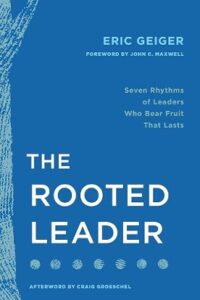
In the opening pages of Rooted: Seven Rhythms of Leaders Who Bear Fruit That Lasts, pastor and author Eric Geiger delivers this sobering statement:
When a tree topples, typically no one is harmed, but a toppling leader damages not only the leader but those surrounding the leader—a family, a company, a congregation. Trust is broken. Dreams and goals seem to be ruined. People are disoriented, struggling to reconcile the beauty that occurred under the leader’s direction with the ugly truth of what has been revealed.
Sadly, we see this toppling far too often. And when a leader falls, the heartache and collateral damage reach further than anyone can measure.
Here are my Book Notes on a resource that marks out the indispensable pathway for becoming a leader who goes the distance.

Chuck Olson
Founder
Lead With Your Life
The Rooted Leader: Seven Rhythms of Leaders Who Bear Fruit That Lasts
Author: Eric Geiger
Copyright: 2026
Book Description:
Our world desperately needs leaders with roots: ones who are deeply grounded, who know who they are, and who are equipped to endure adversity and bear the fruit of vibrant leadership.
Eric Geiger believes that lasting leadership starts beneath the surface. Drawing from the biblical story of Nehemiah—often referred to as history’s first leadership book—Eric offers leaders practical insights on the roots beneath the surface that result in the fruit all leaders desire: vision, conviction, servanthood, perseverance, credibility, transformation, and resolve.
Book Quotes:
When a tree topples, typically no one is harmed, but a toppling leader damages not only the leader but those surrounding the leader—a family, a company, a congregation. Trust is broken. Dreams and goals seem to be ruined. People are disoriented, struggling to reconcile the beauty that occurred under the leader’s direction with the ugly truth of what has been revealed. LOCATION: 341
Because of all the expectations on senior leaders and the heightened public scrutiny, “the probability that a CEO will crash and burn is now higher than ever. From 2000 through 2019, the average CEO tenure in the United States decreased from ten years to less than seven.” LOCATION: 357
If you lead long enough, you will lead through an economic downturn, a market disruption, unfulfilled promises, a natural disaster, a bad hire, a betrayal, undeserved criticism, and perhaps even a global pandemic. LOCATION: 364
A leader is burdened with an overwhelming sense of responsibility to steward their opportunity well and—if they are a good leader—a genuine love for the people on the team and the people being served. The burden is often the storm that is the most tumultuous to a leader’s soul. LOCATION: 367
Every leader lives continually with this battle: Storm intensity vs. root health. When the storm wins, leaders topple, careers end, families mourn, and organizations suffer. LOCATION: 375
If a leader’s platform grows while their heart grows cold, devastation is looming. LOCATION: 381
Being a follower of Jesus turns us into better leaders than we would be if we were not following Jesus. I do not believe and am not suggesting that all Christians are great leaders or that all great leaders are Christians. Rather, I am declaring that a follower of Jesus becomes a better leader of people because Jesus continually transforms His followers. Leaders who follow Jesus are more visionary, convictional, servant-oriented, persevering, credible, familiar with transformation, and filled with more resolve than they would be without Jesus as the center of their lives. LOCATION: 396
Marketplace leadership research keeps “discovering” that humility works, emotional intelligence matters, and character impacts results. Christians have known this for two thousand years, and leaders who are being transformed by Christ are growing in all these attributes. LOCATION: 417
While leaders, like all of us, need accountability and benefit from wise structures, God prescribes actions greater than protection. He does not merely tell us to not go down the road of destruction; He also offers a better path, a way that leads to transformation…All the boundaries and safeguards, even the wise ones, will be insufficient if the leader’s heart is not transformed. LOCATION: 512
The one who is blown away like chaff in the wind delights in the instruction of the ungodly; the one who is rooted and fruitful delights in the instruction of the Lord. The psalmist does not command us to be like strong trees who bear fruit. We can’t make ourselves strong. Instead, the psalmist commends those who delight in the Lord’s instruction. The action we must take that leads to transformation is to delight in God and His Word. LOCATION: 520
The Word is better for us than anything the world offers. According to the psalmist, delighting in the Word is the way we get strong roots and bear fruit. And according to Jesus, the Word is the seed that brings forth good fruit. LOCATION: 538
This man needs no introduction, but let me give him one anyway. Nehemiah led effectively in very different contexts: Persia and Jerusalem. Leaders have studied and written about his visionary and strategic leadership, resulting in the rebuilding of the wall surrounding Jerusalem. Less discussed but more staggering, he led the charge to repopulate the city and change the attitudes of the people. One of the sixty-six books in the Bible is his leadership memoir. Nehemiah did not lead as a prophet or priest but as a chief-of-staff turned visionary builder turned governor. And he excelled in each role. What I appreciate about him the most, and one of the reasons I keep going back to his memoir, is he never toppled. His leadership memoir opens and concludes with prayer, his dependence on God. He is an amazing leader but an even more devoted follower. LOCATION: 552
Because leadership is influence, people without titles or positions can be leaders. And sometimes people with titles and positions are not. Though their job or their email signature can give the impression they are leading, if they are unable to influence people under their care, they are not actually leading anyone. LOCATION: 696
Leadership defined as influence changes the question from “Am I a leader?” to “Am I an effective leader?” or to “Am I a rooted leader who bears fruit in season?” LOCATION: 716
More than a leader having a vision, a vision has a leader. More than you shaping a vision in a brainstorming session, a vision shapes you. LOCATION: 985
Nehemiah did not get away for a “visionary whiteboard session” with friends over lattes. He did not “manifest the vision” on a whiteboard with a blue marker. No, he wept. He was blindsided by an overwhelming burden that ruined his day. LOCATION: 1023
The real need in a conversation about developing a vision is the broken wall a leader is burdened over, the broken wall that must be repaired, the broken wall that frustrates a leadership team or causes them to weep. Leaders who try to leapfrog burden to get to vision arrive at vision without real conviction or power. If you go straight to the felt need of vision without the real need of burden, you are likely to photocopy someone else’s holy cause or rent another organization’s vision. It happens all the time. LOCATION: 1033
The most fruitful visions I have been part of as a leader were birthed from a deep burden over something broken. LOCATION: 1047
It is not only nonprofit leaders and ministry leaders who must begin with burden. Burden is the foundation and the fuel for vision for all leaders in all sectors of society. LOCATION: 1062
The burden over his homeland drove Nehemiah to action. He had to do something. LOCATION: 1097
Napoleon is credited with saying, “The role of the leader is to define reality and then give hope.” The defining reality is the burden over the broken wall, and the hope is the belief that the wall can be rebuilt. Leadership consultant Jim Collins challenges leaders to “confront the brutal facts (yet never lose faith).” Confronting the brutal facts is the burden, and not losing faith is the belief. Max De Pree said, “The first responsibility of a leader is to define reality. The last is to say thank you. In between the two, the leader must become a servant and a debtor.” Defining reality is the burden, and saying “thank you” to those who served alongside only happens when there is the belief that the reality can be changed. LOCATION: 1137
BURDEN without BELIEF = Hopeless Leadership
BELIEF without BURDEN = Purposeless Leadership
BURDEN with BELIEF = Visionary Leadership LOCATION: 1148
You will because you must. And if you don’t yet sense “I must,” the burden is not heavy enough. LOCATION: 1178
The dictionary definition of conviction is a strong belief or the state of being convinced. Similar to vision, more than a leader forming convictions, convictions form a leader. A conviction is a belief that you cannot imagine not holding. To not hold the belief would violate who you are. You hold the belief, and the belief holds you so tightly that you must act. You cannot not. LOCATION: 1309
Without clarity and courage, you don’t get the fruit of conviction. LOCATION: 1435
Clarity without courage is frustration…Courage without clarity is chaos. LOCATION: 1446
Marcus Buckingham wrote, “Clarity is the antidote to anxiety, and therefore clarity is the preoccupation of the effective leader. If you do nothing else as a leader, be clear.” LOCATION: 1454
A mission statement is why the organization, team, or group you are leading exists. A vision is a short-term goal that must be connected to the mission. A documented and consistently articulated set of beliefs and values helps you determine who is on the team and how they are developed. A strategy is how you will accomplish the mission and can also be used to accomplish the vision you are running after for a short season. LOCATION: 1523
Franklin Roosevelt famously said, “Courage is not the absence of fear, but rather the assessment that something else is more important than fear.” LOCATION: 1575
There is a difference between someone serving as an activity and someone serving because their identity is a servant. It is common for someone to engage in the activity of serving without embracing the identity of a servant. Identity always impacts our activity, but activity does not always impact our identity. Leaders who view serving as an activity are less likely to pick up trash when no one is looking or to adjust their approach to meet the challenges of the season. Those who embrace the identity of a servant are the best leaders. LOCATION: 1693
If you are a leader, Nehemiah’s leadership journal is your reality. A common experience for leaders is that whenever something good happens—whenever you get momentum, whenever plans are coming together, whenever a goal is met—struggles and strife seem to come with the progress. In leadership, beauty and pain go together. LOCATION: 2042
The question is not if challenges are looming. The question is if we will persevere through them. LOCATION: 2068
The internal challenges, specifically internal sins, are what topple most leaders, though. They are what prohibit their perseverance. Many leaders are up for an external fight, a fight for what they are passionate about and a fight against what gets in their way. The best leaders, the ones who endure, are the ones who are up for a fight against the sins that threaten to pull them from God’s grace and presence. The best leaders are serious about killing sin so that sin is not killing them. LOCATION: 2235
You can have lots of abilities, but without credibility you won’t be able to lead. You can be a master planner, an incredible communicator, hardworking, visionary, passionate, and gifted at solving problems, but you cannot be a leader without credibility. LOCATION: 2318
The good news is that as your credibility increases, so does your effectiveness. The better news is that you, by God’s grace, can grow in your credibility. Credibility is about believability and trust—people believing in who you are and where you are taking them. LOCATION: 2334
Stephen Covey calls trust “the one thing that changes everything.” Trust affects the speed at which we can innovate and collaborate. LOCATION: 2354
When it comes to personal leadership and to building a team, many have used some variation of these “C” words as a helpful framework: Character: Can I trust you? Commitment: Do you want to be with us? Competence: Can you do the job? Chemistry: Do you fit? Capacity: Can you grow?…When one of the C’s is compromised, credibility takes a hit. LOCATION: 2389
You want your team to be highly credible too because their credibility is good for them and those they serve. A common question from leaders is, “How long do I give someone on my team when there is significant lapse in character, commitment, competence, chemistry, or capacity? How long should I allow for them to remedy the problem?” A wise leader once gave me this insight:[20] Lack of character: Remove the person immediately. Lack of chemistry or commitment: Give the person two weeks to turn around their attitude or their commitment to the team. When I commented that two weeks seemed fast, the leader responded, “How long does it take to repent?” Lack of competence: Give the person six months with coaching, accountability, and other development resources with the hopes of helping the person thrive. Lack of capacity: Give the person as long as the person needs, especially if this person helped get your team or organization to where it is and the role just became too much for them. Give them ample time to find a new spot on the team or somewhere else, but honor the person the whole time. LOCATION: 2602
Change is one leadership action that is both painful and difficult. LOCATION: 2722
The only way we change is if our pain in the current reality is greater than the pain of changing. We see this in our leadership and in our personal lives. We only endure the challenges of personal change when the desire for the fruit on the other side of the change is greater than the comfort of not changing. LOCATION: 2727
Deeply embedded in the posture of leading is change. If you are never leading change, you are living exclusively with a management posture. LOCATION: 2772
Before you are a leader, you are God’s son or daughter. Greater than belonging to your role, you belong to Him. You are His friend, His child, His beloved, His servant, and His treasured possession. When Jesus is our greatest identity, our lesser identities, such as our roles or our titles, can change without losing who we ultimately are. As we follow Jesus, we still retain the identities of our family, our profession, and our hobbies, but Jesus is the greater identity. Thus, we can more confidently navigate the challenges of this life and more boldly lead in our other roles as our greatest identity cannot be taken from us. Resting in Him makes our restlessness sacred by purifying our motives and reminding us that our identity is already secure. LOCATION: 3278
Note: should you wish to find any quote in its original context, the Kindle “location” is provided after each entry.

Chuck Olson
More Book Notes
Compiled by Chuck Olson
Compiled by Chuck Olson
Compiled by Chuck Olson
Sign Up for Free Resources via Email