Compiled by Chuck Olson


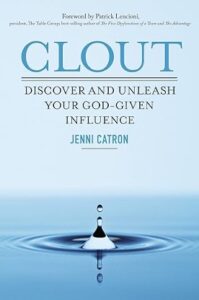
Early in the pages of her book Clout: Discover and Unleash Your God-Given Influence, author and leadership coach Jenni Catron presents her convincing case: Clout is the influence that God has given to you and to no one else. You are specifically designed to impact the world in a way that no one else can. Discovering your clout is an essential part of unleashing your purpose. You have a specific purpose, a calling, that only you are qualified to fulfill. Your God-given influence defines your purpose. Your purpose establishes your leadership. Your leadership makes a mark on the world. From there, she talks about both the challenges and opportunities that attend how to leverage the influence God has entrusted to each of us and to do so not for self-interest but for the advancement of His purposes.
Check out these Book Notes to get a picture of how Clout will expand your understanding of how to maximize your influence.

Chuck Olson
Founder | Executive Director
Lead With Your Life
Clout: Discover and Unleash Your God-Given Influence
Author: Jenni Catron
Copyright: 2014
Book Description:
It is easy to believe that power, influence, and leadership are gifts given to a special few. But the Bible says otherwise.
We all long for significance, even as we fear we will never be good enough. We listen for God, but hear only voices of doubt and practicality. Listen again. There is a call that only you can answer.
Clout is power and influence. It is an undeniable trait that opens doors and moves mountains. You have it, and you can use it to change the world around you. With Scripture and stories from her own life, Jenni Catron maps out the pitfalls and clear paths on the way toward discovering and unleashing your very own clout.
This is not a quest of power for power’s sake. Influence is not a guarantee of fame or fortune. It is an opportunity to use your gifts to do the extraordinary. This is a journey toward dismantling what stands in the way of your influence and leadership, discovering your God-given clout, and using it to answer God’s calling on your life.
Learn about Jesus and others who sought to lead like him. Stop dreaming and start planning. Define your direction, set your goals, and confront the challenges that stand between you and the person God made you to be. Step into your sphere of influence with the humble confidence of Christ.
Book Quotes:
Clout is the influence that God has given to you and to no one else. You are specifically designed to impact the world in a way that no one else can. Discovering your clout is an essential part of unleashing your purpose. You have a specific purpose, a calling, that only you are qualified to fulfill. Your God-given influence defines your purpose. Your purpose establishes your leadership. Your leadership makes a mark on the world. LOCATION: 208
When we discover and unleash our God-given influence, we position ourselves to lead with passion and purpose that defy our personal limitations. That’s what clout is all about.
LOCATION: 242
Unleashing your God-given influence means leading your life from a place of deep purpose and confidence. It’s taking what you’ve been given and using it to do the remarkable. It’s recognizing that little in life happens by accident, but you can use everything in life for a purpose that is greater than yourself. Influence is recognizing that you are making a mark on others whether or not you’re trying to do that. Influence is understanding that what you do today matters, so give it everything you’ve got. LOCATION: 257
Fear is the front-runner of the clout killers. As we begin to unpack these inhibitors to our confidence and influence, we’ll see a consistent theme of fear. Fear tends to coerce its tentacles into all our issues. LOCATION: 301
We must confront our fears with the truth, and that truth is the powerful reminder of God’s constant presence. LOCATION: 397
I believe that God allows us to be confronted repeatedly with fear in order to remind us of the power of truth. Every hurdle of fear is an opportunity for our faith to grow. LOCATION: 432
Comparison is a clever clout killer because at a surface level it doesn’t look all that dangerous. It’s the fuel that propels us forward. It’s often the motivation to do greater things. Comparison in our culture is natural, perhaps even expected. LOCATION: 477
Replacing comparison in our lives begins with making a concerted effort to focus on discovering and unleashing our God-given influence. Comparison holds us back and distracts us from this purpose. It keeps our focus on what we don’t have rather than on what we do have. LOCATION: 601
Jealousy is the irrational fear of losing something or someone valuable to you—with an emphasis on losing to someone else. LOCATION: 639
The most valuable thing that we as leaders stand to lose is our clout. Jealousy sabotages our influence when we fear losing our influence to another person who shares our arena. It could be the coworker who is getting more of the boss’s attention. It could be the new committee member whose ideas are constantly celebrated. It could be the friend who is always the center of everyone’s attention. LOCATION: 642
Jealousy keeps us on a perpetual quest for the attention, affection, and affirmation of others. We’re constantly comparing ourselves to others, and if someone has something we lack, jealousy starts strategizing about how to get it back. LOCATION: 649
The antidote to jealousy and envy is to replace them with affirmation and celebration of the influence of others. Jealousy and envy tempt us to diminish the worth of others. The best way to combat the negative progression of these clout killers is to go the opposite direction by affirming and celebrating the influence of others. LOCATION: 778
Scarcity in this context is birthed from an unnecessary fear that causes us to live and lead with the fear that if we give more, we won’t have enough. LOCATION: 861
The real test of leadership and influence is when we’re willing to stand behind others and let them shine. It’s not that there aren’t strategic moments when your specific gifts will require you to be the person up front, but the test is whether you can give up the limelight. LOCATION: 955
Generous leaders are contagious. Generosity multiplies our clout. Our God-given influence thrives and blesses others. Our generosity shows up in the same ways that scarcity did—through our words, our time, and our opportunities. LOCATION: 989
Your clout becomes compromised when you experience a perpetual lack of confidence. Insecurity is sparked by fear and antagonized by doubt. Insecurity causes us once again to wrestle with the “I am not enough” fear. Not good enough, strong enough, smart enough, kind enough, beautiful enough, witty enough, creative enough, “you fill in the blank” enough. LOCATION: 1080
In my experience, most of us don’t begin recognizing the impact of our insecurities on our influence until we have influence for them to impact. In other words, we recognize the danger of our insecurities when something is at risk. LOCATION: 1107
For leaders, insecurity can assume dangerous disguises. Often when we think of insecure people, mousy, timid, wallflower types come to mind. But that’s not typically what insecurity looks like for leaders. Perhaps that is why we’re so prone to ignore it; we don’t always recognize it. LOCATION: 1151
But that’s the trouble with insecurity. It’s never enough. Insecurity always sees what is missing about oneself. LOCATION: 1159
The most surprising thing I have learned about insecurity is that insecurity makes you selfish and self-focused. Ironically it is the opposite of what I thought I was. I thought I was being sensitive to the needs and perceptions of others, but I was only sensitive to others because of how it impacted me. LOCATION: 1204
Pride is like a facade on the exterior of our souls. We use it in the attempt to disguise our other clout killers. While our fears and insecurities cover us layer upon layer, pride quickly responds with a false exterior to tidy it all up. Pride fools others and us into believing that we’ve got it all together. We become unrecognizable to ourselves. We’re rarely aware that we’ve built this facade, which makes it all the more difficult for us to identify when pride is impacting our influence. LOCATION: 1276
Pride feeds our longing for perfection. It’s a quest for competency. We want to be the best. We want to give our best. Pride says that you must prove your worth and perform your way to acceptance. Pride finds all its value and worth in your accomplishments and sends you spinning emotionally out of control when you don’t measure up to the expectations you have created for yourself. Pride finds its value in what you do rather than in who God says you are. Pride can’t be comfortable with imperfection. LOCATION: 1361
A humble heart opens itself up; a prideful heart stays closed and protective. A humble heart listens to others; a prideful heart resists feedback. A humble heart asks questions; a prideful heart moves forward independently. A humble heart seeks out others; a prideful heart keeps its distance. LOCATION: 1439
Where pride finds its identity in perfection, importance, performance, and independence, humility allows us to anchor our identity in Christ first and live from a place of confidence in Christ in us. LOCATION: 1449
• Insecurity says you are not good enough, and in an attempt to prove you can handle it, you control.
• Scarcity suggests that there is not enough power to go around, so you control your territory by edging others out.
• Comparison causes you to try to control your circumstances so that you can keep pace with others.
• Pride motivates you to try to prove your value by being the one to direct all the answers.
• Fear says you cannot fail, so you must control everything and everyone. LOCATION: 1552
The most dangerous place for us to be is in a situation where we feel that we’ve got it all under control in our own abilities. I believe God does his greatest work through us when we are aware of our limitations and have to trust and lean into him for outcomes that are too big for us to tackle on our own. LOCATION: 1623
So how do you effectively replace control with trust and faith? First, acknowledge your dependence on God. Recognize that you are not intended to handle life on your own, and you cannot do it on your own. Remember that you are just a steward. You are responsible only to be faithful. God is responsible for outcomes. Second, accept your limitations. Take off the cape. You are not designed to be a superhero. Your limitations are reminders to own what you can and release control of what you can’t. You must learn to manage the tension of being responsible for what you can but being dependent enough to know that God works through you to accomplish it all. Third, embrace the opportunity to work with others. Being the leader doesn’t mean that you have to direct every idea or decision. When you control, you limit the power that comes from a team working effectively together. When you control, you take the role of the dictator. Everyone else becomes your subject and either submits or revolts. As a leader, you release control in exchange for a spirit of partnership. LOCATION: 1629
See how early we begin to define who we are by external factors and others’ expectations? Herein lies the dilemma. We learn to describe ourselves by our roles and responsibilities rather than by our unique God-given influence. It’s not that any of these things are bad. It’s part of life. Having accomplishments and goals is important to succeeding in life and even fulfilling all God has called us to. When we first define ourselves by these external forces, however, we never learn to define who we are without them. As a result, we begin to create a false self that forgoes an understanding of who we really are at our core. LOCATION: 1701
One of the greatest dangers to understanding your true self is allowing the pressures of the norms to squeeze out the very things that make you distinct. Your identity is core to your clout, and when you allow society to define it, you’ve distorted the picture. LOCATION: 1802
If you want to lead a life of influence that impacts the world and those you lead, you have to be willing to confront the issues that hold you back. Don’t let what could be great become mediocre because you’re not doing the self-evaluation necessary to continue to grow. LOCATION: 1856
I believe with all my heart that God calls each of us to great things. His plans and purposes for us are beyond our wildest imaginations. But they will simply be imaginations and unmet expectations if we skip over this deep understanding of who we are in him. It begins and ends there. We are nothing apart from him. LOCATION: 1954
We must discover our core identity to unleash our true, God-given influence. Forces are working against us to derail our purpose and diminish our hope. If we haven’t done the exploring, we leave ourselves vulnerable to despair and hopelessness. LOCATION: 2055
Before sin messed things up, work was still a part of our lives. God attributed significance to work even before it was a result of our sin. We were made to work. LOCATION: 2086
I define God-given influence as “the collection of nuances that make you unique.” God has given each one of us a specific set of gifts, talents, personality, and experiences. This one-of-a-kind collection is your clout, and it’s been given to you for the specific work God has for you to do. To discover and unleash your God-given influence, you have to hunt for all the pieces. LOCATION: 2122
Stewardship, on the other hand, recognizes that I’ve been entrusted with something valuable and I have a responsibility to give it my best care. I don’t own it, but I’ve been given an amazing privilege. LOCATION: 2268
The act of putting ideas to paper moves them from pipe dreams to possibilities. LOCATION: 2368
Vision statements give us an anchor for those days we feel that we’re floundering. LOCATION: 2381
If you’ve never written a personal vision statement, I encourage you to draft one. Here are suggestions to get you started:
1. Observe the formula. Vision statements are a combination of defining what you do and who is involved.
2. Brainstorm a list of action words that describe what you feel called to do. Look back through your gifts, talents, and experiences for consistencies and themes. Write them down, and keep refining the list. You may choose to do this over the course of a week as you let yourself live with the words and concepts.
3. Consider who you feel called to serve. From what groups of people do you get energy when you are pouring yourself out to serve them? Do you love teaching Sunday school? Do you thrive when you’re leading a small group? Do you enjoy serving homeless or underresourced people? Do you thrive when you’re connecting business leaders? If you’re not immediately certain of who you most feel called to serve, take a couple of weeks, and observe your level of engagement in different environments. Your who will likely emerge as you watch for it.
4. Start crafting your whats and whos into statements. Don’t be afraid to write several statements until you think you have the right combination. You probably won’t get it exactly right the first time you sit down to do it. Take a week, and spend thirty minutes every day refining it until it feels right.
5. Give your statement to a couple of close friends, and ask for their feedback on how well it describes who God has designed you to be. Consider their feedback and how it might apply. 6. Pray over your vision statement. Ask God to affirm or clarify what you’ve drafted.
7. Place your vision statement somewhere you can read it every day. LOCATION: 2402-2409
Here are my guiding principles:
• I represent a balanced lifestyle.
• I value the relationships with my family and friends and diligently seek to grow these relationships.
• I pursue excellence in all aspects of life: professional, personal, spiritual, and physical.
• I am forever a student.
• I listen well and effectively articulate my thoughts.
• I embrace the gifts God has given me and use them with confidence.
• I demonstrate compassion and patience.
• I am not easily offended. I acknowledge my failures, inconsistencies, and weaknesses and seek to improve them. LOCATION: 2425
We all have excuses or reasons for why we can’t be who God is calling us to be, but when we throw aside the excuses and resist our enemies, we begin to see our creative best birthed as we live from our God-given influence. LOCATION: 2498
A statement that has become common is, “Give others the gift of going second.” As leaders, we must go first in order to give others the gift of going second. Be the first to be truthful. Be the first to be encouraging. Be the first to affirm someone else. Be the first to be generous. Be the first to be compassionate. Be the first to be humble. Be the first not to compare. Be the first to speak truth. Be the first to display faith. LOCATION: 2552
Note: should you wish to find any quote in its original context, the Kindle “location” is provided after each entry.

Chuck Olson
More Book Notes
Compiled by Chuck Olson
Compiled by Chuck Olson
Compiled by Chuck Olson
Sign Up for Free Resources via Email